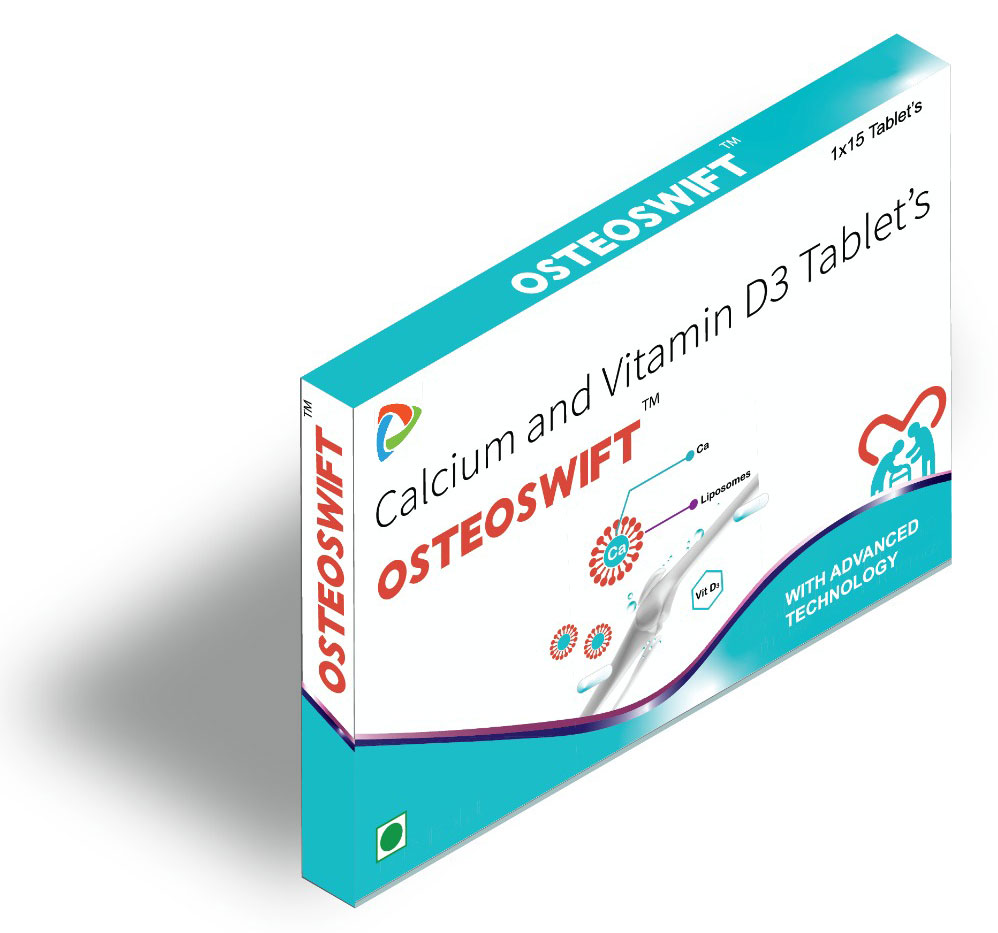
Dosage & Administration:
OD and BID as directed by doctor
Product: Osteoswift (ऑस्टियोस्विफ्ट)
Osteoporosis, to heal fractures, post-menopausal osteoporosis, osteopenia, osteomalacia, to maintain BMD, to treat calcium and vitamin D deficiency
Hypersensitivity to the active substances or to any of the excipients of formulation. Hypercalcaemia, hypercalciuria, nephrocalcinosis, nephrolithiasis, disease and/or conditions which lead to hypercalcaemia and / or hypercalciuria (e.g. primary hyperparathyroidism, myeloma, bone metastases), hypervitaminosis D, severe renal impairment and renal failure.
Actions:
Tricalcium Phosphate as Liposomes:
Tricalcium Phosphate is a crucial mineral for bone health, as it constitutes a significant portion of the bone structure. Tricalcium Phosphate as liposome is a form of calcium that is easily absorbed by the body, making it an effective supplement for individuals with low calcium intake. It provides the raw material necessary for bone mineralization and helps in maintaining bone density.
Vitamin D3:
Vitamin D3 plays a vital role in regulating calcium and phosphorus absorption in the intestines. Adequate levels of vitamin D is essential for the efficient utilization of calcium from the diet. It also helps in the proper mineralization of bone, preventing conditions like osteoporosis. Vitamin D is mainly obtained through exposure to sunlight, and deficiency can lead to impaired bone health.
Why Liposome of TCP?
Liposomes are tiny, spherical vesicles made of one or more phospholipid bilayers that self-assemble in water. They are biocompatible, can be used to encapsulate both water-soluble and fat-soluble substances.
Liposomal TCP ensure controlled and targeted release of calcium.
Taking the Osteoswift tablet may cause some side effects. Here are a few common ones to be aware of:
- Constipation: You may experience difficulty passing stools regularly.
- Upset stomach: You might feel discomfort or pain in your stomach.
Some drugs that can interact with Osteoswift tablet include:
- Diuretics: hydrochlorothiazide, furosemide
- Anticonvulsants: phenytoin, phenobarbital
- Steroids: prednisone, dexamethasone
Drug-Food Interactions
There are no specific food or beverage interactions known with Osteoswift tablet.
Drug-Disease Interactions
It is important to seek safety advice from a doctor if you have kidney disease or liver disease before taking Osteoswift tablet.
- Store the Osteoswift tablet below 30°C.
- Keep the product out of the reach of children and away from light and moisture.
- Use the product before its expiration date.
Pregnancy
If you are pregnant or planning to become pregnant, it's important to consult your doctor before taking Osteoswift tablet. They will assess the benefits and risks for you and your baby.
Breastfeeding
Before using Osteoswift tablet while breastfeeding, consult your doctor. They will guide you on whether it is safe for you and your baby.
Alcohol
It is recommended to consult your doctor regarding alcohol consumption while taking Osteoswift tablet to ensure its safe use.
Liver
If you have liver disease or any liver-related concerns, seek advice from your doctor before starting Osteoswift tablet.
Kidney
If you have kidney disease or any kidney-related issues, it is advisable to consult your doctor before using Osteoswift tablet.
Using Machines & Driving
The Osteoswift tablet does not usually affect your ability to drive or operate machinery. However, if you experience dizziness or any other side effects, it's best to avoid these activities and consult your doctor.
Allergy
Inform your doctor if you have any known allergies to the ingredients in Osteoswift tablet or similar medications.
Children
Osteoswift tablet is not recommended for use in children without proper medical advice.
Older Patients
Older patients may require special precautions when using the Osteoswift tablet. Consult your doctor for personalised guidance based on your specific health conditions.
| Calcium Salt | Elemental Ca % | Amount Needed for 250 mg Ca | Estimated Fractional Absorption | Estimated Actually Absorbed (mg) |
|---|---|---|---|---|
| Calcium Carbonate (CaCO₃) | 40% | 625 mg | 22.5% | 56 mg |
| Calcium Citrate-Malate (CCM) | 23.5% | 1,064 mg | 35% | 88 mg |
| Liposomal Tricalcium Phosphate (liposomal TCP) | 38.7% | 645 mg | 25–45% | 63–113 mg |
| Parameter | Liposomal Tricalcium Phosphate (TCP) | Calcium Carbonate | Calcium Citrate Malate (CCM) |
|---|---|---|---|
| Elemental Ca % | ~38.7% | ~40% | ~21% |
| Amount needed for 250 mg Ca | ~650 mg | ~625 mg | ~1190 mg (1.2 g) |
| Absorption | Very high due to liposome delivery | Moderate, requires high stomach acid | High, stomach-acid independent |
| GI Tolerance | Best (gentle, no gas/acidity) | Worst (causes acidity, gas, constipation) | Good (regarded as GI-friendly) |
| Solubility | Medium, improved by liposomal encapsulation | Low in neutral pH | High |
| Best for | Elderly, low-acid patients, gastric bypass, IBS | Young adults with good stomach acid | Kids, elderly, GERD patients |
| Food requirement | Works with or without food | Must take with food | With or without food |
| Phosphate content | Yes (supports bone mineralization) | No | No |
| Taste/Palatability | Neutral | Chalky | Slightly tart |
| Cost | High | Low | Moderate-high |
| Feature | Liposomal Tricalcium Phosphate (TCP) | Calcium Carbonate (CaCO₃) |
|---|---|---|
| Absorption Mechanism | Absorbs via liposomes directly into intestinal cells; does not need stomach acid | Needs high stomach acid; low absorption if acid is low |
| Bioavailability | High – more calcium reaches bloodstream even at lower doses | Moderate to low in elderly, post-operative, GERD, PPI users |
| Digestive Tolerance | Very gentle on stomach; no gas, bloating, constipation | Often causes gas, bloating, acidity, constipation |
| Effectiveness in Low Acid Conditions | Excellent – works even in achlorhydria or PPI therapy | Poor – almost no absorption if stomach acid is low |
| Dose Efficiency | Lower dose gives higher usable calcium | Higher mg needed to get same effect |
| Kidney Stone Risk | Lower – calcium is better regulated | Higher – unabsorbed calcium can precipitate |
| Food Requirement | Works with or without food | Works only with food |
| Clinical Suitability | Ideal for elderly, ICU, post-surgery, hepatic/renal patients | Suitable only for healthy adults |
| Side Effect Frequency | Very low | High digestive discomfort |
| Additional Benefit | Includes phosphate → supports bone mineralization | No phosphate; may disturb calcium–phosphate balance |
| Parameter | Liposomal Tricalcium Phosphate (L-TCP) | Calcium Citrate Malate (CCM) |
|---|---|---|
| Absorption | Liposomal delivery bypasses GI barriers → direct cellular uptake | Absorbed through normal GI pathways |
| Bioavailability | Very High – phospholipids enhance transport, less dependency on stomach acid | Moderate – good, but requires optimal stomach pH |
| Gastric Tolerance | Excellent – gentle on stomach, no bloating or acidity | Can cause mild acidity or gastric load in some |
| Required Dose | Lower dose needed due to high absorption | Higher dose needed for similar effect |
| Bone Deposition | Superior bone mineralization because TCP structure is closer to natural bone mineral (hydroxyapatite-like) | Good bone deposition but slower compared to phosphate-based salts |
| Phosphate Content | Yes (very important for bone matrix formation) | No phosphate – only calcium + citrate + malate |
| Use in Deficiency States | Highly effective in moderate/severe deficiency due to enhanced cellular delivery | More effective in mild/moderate deficiency |
| Effect in Low Acid (Elderly) | Absorption is unaffected | Absorption decreases in low-acid environment |
| Taste & Palatability | Neutral taste due to encapsulation | Slightly acidic taste |
| GI Side Effects | Minimal – liposomes protect GI mucosa | May cause mild constipation or gastric discomfort |
| Suitability in Malabsorption | Best choice – liposomal form bypasses common absorption issues | Moderate – still depends on intestinal absorption efficiency |
| Stability | Highly stable, protected from degradation | Fairly stable but affected by pH |
| Onset of Action | Faster – direct cellular uptake | Slower – requires breakdown and ion release |
 Chat with us
